
Invisalign vs. Braces for Adults: How to Actually Choose
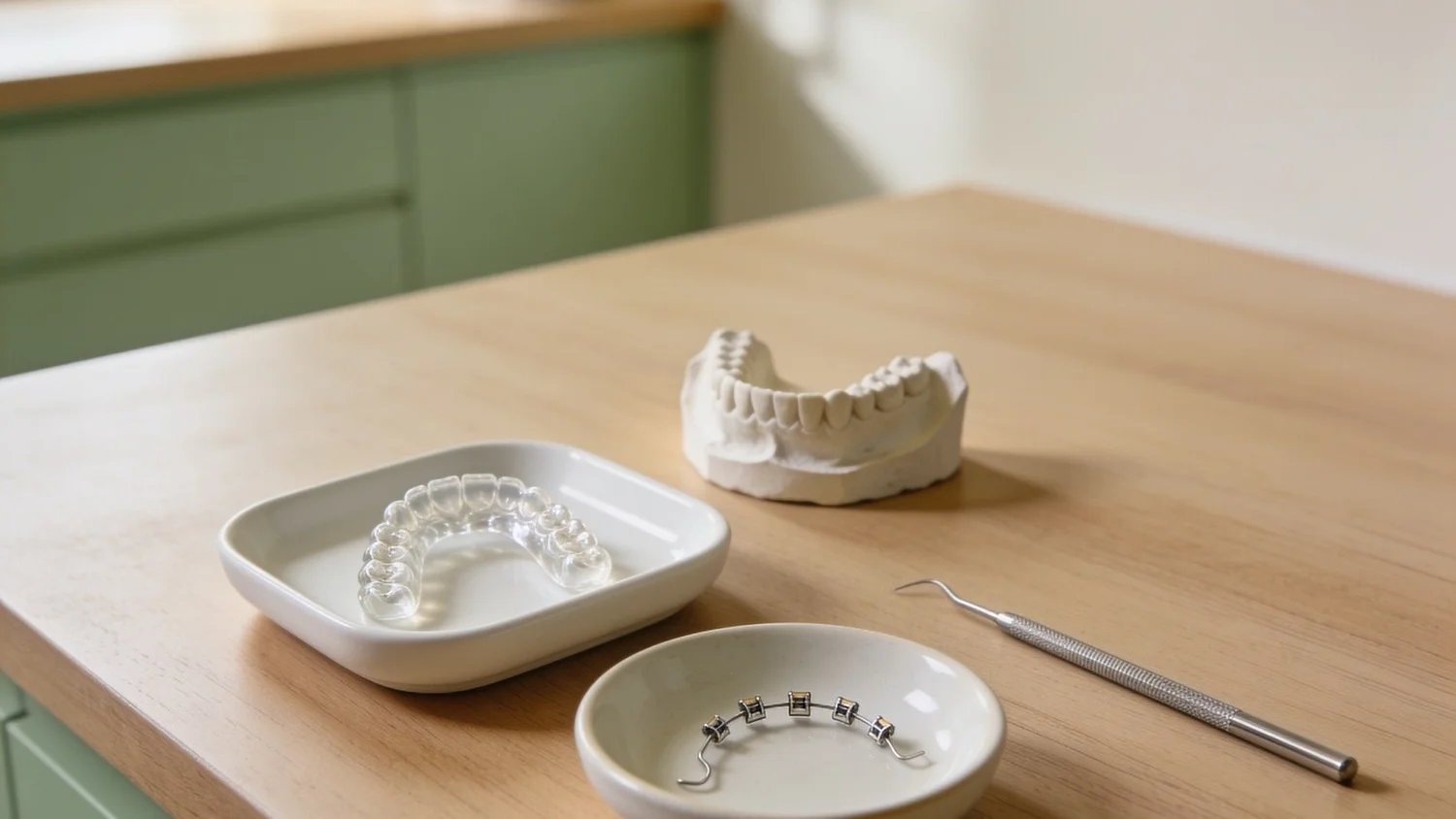
For most adults, Invisalign and traditional braces both work. The choice comes down to two things: how complex your case is, and how you actually live. Clear aligners are the better fit for mild to moderate crowding, spacing, and simple bite corrections in an adult who can keep the trays in 20 to 22 hours a day. Braces are the better fit for severe crowding, large rotations, significant bite or jaw discrepancies, and for anyone who knows that a removable appliance will end up in a drawer. A practice that offers both has no reason to steer you.
Last updated: August 7, 2026
Total Health Dental Care provides both traditional orthodontic braces and Invisalign clear aligners, planned in-house by an orthodontist rather than referred out. Dr. Darryl Caesar, the orthodontist at the Rotunda Specialty Center at 300 Frank H. Ogawa Plaza Suite 100 in downtown Oakland, evaluates both paths in the same visit. This guide lays out what actually separates the two so that you walk into that consultation already knowing which questions matter.
What is the honest difference between Invisalign and braces for adults?
Braces are fixed. Metal brackets are bonded to each tooth and connected by an archwire, and the appliance works whether or not you think about it. Your orthodontist adjusts the wire every four to eight weeks, and the surrounding bone remodels to support the new tooth positions.
Invisalign is removable. You wear a series of custom clear trays, each one shaped slightly straighter than the last, replacing the set every one to two weeks. Nobody has to see it, and you take it out to eat. The trade is that the appliance only works while it is in your mouth, so the daily dose is your responsibility rather than the responsibility of the wire.
Everything else people argue about downstream of that difference comes back to the same fact: one appliance is always on, and the other is only on when you put it on.
How do Invisalign and braces compare side by side?
| What you are comparing | Invisalign clear aligners | Traditional braces |
|---|---|---|
| How it moves teeth | A sequence of custom trays, each slightly straighter than the last, changed every one to two weeks | Brackets bonded to every tooth and joined by an archwire that is tightened at each visit |
| Who controls the daily dose | You. Treatment stays on schedule only at 20 to 22 hours of wear a day | The appliance. It applies pressure around the clock with no decision required |
| Visibility at work | Nearly invisible, though tooth-colored attachments may be bonded to some teeth to grip the tray | Visible. Metal brackets and wire are apparent in conversation and on camera |
| Typical adult timeline | Often around 12 to 18 months, and as little as 6 months in simple cases | Often about 18 to 24 months, and longer for complex corrections |
| Visit rhythm | Short progress checks to hand off new tray sets and confirm the teeth are tracking | Adjustment appointments every four to eight weeks, plus a placement visit of one to two hours |
| Eating and drinking | No food restrictions, but trays come out for everything except water, and teeth get brushed before they go back in | No removal needed, but hard, sticky, and chewy foods are off the menu for the whole treatment |
| Keeping teeth clean | You brush and floss normally with the trays out | Brushing after every meal and daily flossing with threaders around the wire |
| Handles best | Crowding, spacing, arch expansion, relapse after childhood orthodontics, many moderate bite corrections | Severe crowding, large rotations, significant overbite, underbite, crossbite, and jaw discrepancies |
| Where it struggles | Rotating rounded teeth such as canines and premolars, pulling a tooth down into the arch, and fine root angle and torque control | Appearance, hygiene difficulty, and diet limits rather than the mechanics of tooth movement |
| Between-visit problems | A lost or cracked tray, usually solved by returning to the previous set until you are seen | A broken bracket or a wire poking the cheek, which needs an unscheduled visit |
| After treatment | Retainers, indefinitely | Retainers, indefinitely |
Which one is faster for adults?
Close enough that speed alone is a weak reason to choose. In published comparisons of adult patients, average treatment time has come out near 14.5 months for clear aligners against 16.2 months for conventional braces, a gap of well under two months.
The more useful finding is that the answer flips with the case. Reviews that separate cases by type report no meaningful difference in treatment quality or duration between aligners and fixed appliances in non-extraction cases. When teeth have to be extracted to make room, fixed appliances have finished faster.
Compare that with the estimates from the Total Health Dental Care service pages: many adult Invisalign cases run about 12 to 18 months, with simple cases finishing in as little as 6 months, while braces treatment often lasts about 18 to 24 months. Those are averages across many mouths. Your own estimate comes from the treatment plan built on your scan, not from a range in an article.
Which cases still need traditional braces?
Aligners have become capable enough that many adults who assume they need metal are candidates for trays. But the limits are real, and they are specific rather than vague.
Published work on aligner predictability consistently identifies the same difficult movements. Rotating a rounded tooth is one: canines and premolars have cylindrical crowns that give a smooth plastic tray very little to grip, and rotations beyond roughly ten degrees are among the least predictable movements in aligner therapy. Extrusion, meaning pulling a tooth down into the arch, is another. So is precise control of root angle and torque, which is what determines whether teeth end up upright over their roots rather than merely straight-looking at the crown. Reviews also find aligners weaker at establishing full biting contact between the upper and lower back teeth.
This is why bite problems matter more than crooked front teeth when the decision gets made. A significant overbite, underbite, crossbite, or a real jaw discrepancy is the classic case for fixed appliances, which can apply the kind of controlled force that moves roots and not just crowns. The Total Health Dental Care orthodontics page says the same thing plainly: metal braces can address severe misalignment that other treatments cannot handle.
Two practical notes. First, the answer is often both rather than either, since braces for a phase followed by aligners is a normal plan. Second, if a provider promises a complex bite correction with aligners alone and offers no explanation of how the difficult movements will be achieved, that is a reasonable moment to ask for a second look at the treatment plan.
Can you really wear aligners 20 to 22 hours a day?
This is the question most adults answer too optimistically, and it deserves an honest number.
Twenty to 22 hours a day means the trays are out only for meals, for anything you drink other than water, and for brushing and flossing. A long lunch, a coffee, a dinner with a glass of wine, and an evening you forgot about can quietly cost four hours.
Studies that measure wear objectively rather than by self-report find the gap plainly. Measured average wear has landed around 15 hours a day, roughly two thirds of what the plan assumes, and patients have been found to overstate their own wear by about five hours a day. When wear falls short, the teeth stop tracking the plan, the trays no longer seat fully, and treatment stretches out or needs a new scan and a fresh set of aligners. Refinement rounds are ordinary rather than a failure, and research on aligner accuracy, which puts predicted-versus-achieved movement near half, is part of why.
None of that is an argument against aligners. It is an argument for being honest with yourself before you choose. If you graze all day, travel constantly, or already know you will not put something back in your mouth after every coffee, braces will finish sooner in your hands even though the published averages say otherwise.
Which option is easier on your gums during treatment?
Aligners, and this is one of the clearest findings in the comparison literature.
Because the trays come out, you brush and floss the way you always have. Systematic reviews comparing the two appliances report significantly better plaque scores, gingival scores, probing depths, and bleeding on probing in aligner patients. Reviews also report that the risk of white spot lesions, the chalky demineralized marks that can be left behind around brackets, is roughly ten times lower with aligners than with fixed appliances.
Braces are not a sentence to gum disease. They simply demand more from you: brushing after every meal, daily flossing with threaders under the wire, and keeping your regular cleanings on the calendar for the full one to two years. Patients who do that finish with healthy gums. Patients who do not are the reason the averages look the way they do.
This matters more for adults than for teenagers. Adults arrive with existing restorations, some recession, and often a history of gum disease, and moving teeth through compromised bone is a different job than moving them through healthy adolescent bone. Ask for a periodontal evaluation before either appliance goes on. At Total Health Dental Care the periodontist works in the same building as the orthodontist, so that question gets answered without a referral out.
What drives the cost of each, and how do you get your number in writing?
There is no single price for either option, and any practice quoting one before it has looked at your teeth is guessing. The orthodontics page at Total Health Dental Care lists the honest drivers: case complexity, how long treatment runs, the location, and the fees of the provider, plus any additional procedures such as extractions.
A few things reliably move the number for adults. Length of treatment is the big one, since more months mean more aligner sets or more adjustment visits. Complexity is next, because a case needing extractions, anchorage devices, or a combination of braces and aligners costs more than closing a small gap. Whether a general dentist or an orthodontist plans the case matters too. And single-arch treatment, where only the top or bottom is treated, is a different figure than treating both.
Here is how to get a real number rather than a range:
- Ask for the total case fee in writing, not a monthly payment. A low monthly figure stretched over a longer term can cost more overall.
- Ask what the fee includes and excludes. Retainers, refinement aligners, and mid-treatment records are the three items most often quoted separately.
- Ask what happens if treatment runs past the estimate. Get the answer before you start, not at month 20.
- If you carry a PPO, ask the office to verify your orthodontic benefit and your lifetime orthodontic maximum specifically. Orthodontic coverage often works on a separate lifetime cap rather than the annual cap.
- Ask about pre-tax dollars. Health Savings Accounts and Flexible Spending Accounts can be used for orthodontic treatment, which changes the effective cost without changing the fee.
Total Health Dental Care accepts every major PPO, verifies benefits and presents all costs upfront before treatment begins, and offers payment options including no-interest financing. If you have no insurance at all, the $600 Loyalty Plan is the relevant path: it takes 50 percent off every specialty service performed in-house, orthodontics and Invisalign included, up to $2,000 of savings in a plan year against the roughly $1,000 annual cap typical of dental insurance, and it includes a free Invisalign consultation and 3D scan valued at $350 at signup. The $300 Cleaning Plan covers preventive care worth about $710 and does not include treatment discounts. There is more detail in the membership plan versus insurance comparison and in the guide to what dental work really costs without insurance.
Do you still need a retainer either way?
Yes, and the requirement is identical. This is the part adults most often get wrong, usually because they got it wrong the first time.
Teeth do not lock into their new positions when the appliance comes off. The fibers and bone around each tooth keep remodeling, and without retention most patients see meaningful relapse within five to ten years, with the lower front teeth typically the first to crowd again. The American Association of Orthodontists position is that teeth continue shifting throughout life, which is why indefinite nighttime retention is now the standard recommendation rather than a temporary phase.
A typical schedule is full-time wear for the first few months, then nightly for a year or two, then a few nights a week indefinitely. Clear aligner patients sometimes assume they are exempt because the trays already looked like retainers. They are not. Relapse after aligners behaves the same way it does after braces.
A large share of adult orthodontic patients are in the chair a second time precisely because a retainer stopped being worn after teenage braces. Budget for retainers as part of the case from day one, and ask whether replacements are included.
How should you actually decide?
Work through these in order. The first four are about your teeth, the last three about your life.
- Is the problem the bite or the appearance? A real bite or jaw discrepancy pushes toward braces or a combined plan. Crowding and spacing with a functional bite opens the aligner door.
- Does the plan require rotating canines or premolars, or pulling a tooth down into the arch? Those are the movements aligners handle least predictably. Ask directly how the plan achieves them.
- Are extractions part of the plan? If yes, ask specifically about timeline, since fixed appliances have finished extraction cases faster in published comparisons.
- What is your gum health right now? Get a periodontal evaluation before anything is bonded or scanned.
- Will you honestly keep trays in 20 to 22 hours a day? If the honest answer is no, the fixed appliance is the faster route for you regardless of the averages.
- How visible is your job? If you present, teach, or sell face to face every day, that is a legitimate input rather than vanity.
- What does the total cost look like in writing, including retainers and refinements? Do not start until you have seen it.
If you have already had orthodontics once and your lower front teeth have crept back, that is the single most common adult case, and it is usually the one where clear aligners perform well and finish quickly.
Where can an East Bay adult get evaluated?
Both paths are planned in-house at Total Health Dental Care by Dr. Darryl Caesar, the orthodontist based at the Rotunda Specialty Center at 300 Frank H. Ogawa Plaza Suite 100 in downtown Oakland, two blocks from 12th Street BART. Because the orthodontist, the periodontist, the oral surgeon, and the endodontist all work in the same building, a case that needs an extraction, a gum evaluation, or a root canal before teeth start moving does not turn into a referral and a two-month wait. That is the same in-house structure behind same-day treatment across the East Bay.
The Invisalign consultation with Dr. Caesar is free. It includes a 3D digital scan, a treatment plan showing the projected movement of your teeth with an estimated timeline, and in many cases a digital preview of the projected result before anything begins. It is also the visit where you find out whether braces, aligners, or a combination fits your case, which is exactly the answer this article cannot give you. If you want the cost and timeline side in more depth first, read the guide to Invisalign in the East Bay.
Call (510) 495-1075 or book online. Berkeley patients are usually seen at the Dana Street or Telegraph Avenue offices, Oakland patients at Grand Avenue, Temescal, Piedmont Avenue, Montclair, 15th Street, or Old Oakland, with the specialty work concentrated at the Rotunda.
Frequently asked questions
Is Invisalign as effective as braces for adults?
For mild to moderate crowding and spacing, published comparisons find both approaches effective, with similar quality and duration in non-extraction cases. For severe crowding, large rotations of rounded teeth, or significant bite and jaw discrepancies, fixed braces remain more predictable. Case complexity and your own compliance, not brand preference, are what decide it.
Does Invisalign hurt less than braces?
Generally yes. Invisalign is not usually painful, though pressure or soreness for a day or two is normal when you start a new aligner set, and that discomfort is typically less than what patients report with traditional braces. Braces also carry their own irritations that aligners do not, such as a bracket that comes loose or a wire that catches the cheek.
What happens if I do not wear my aligners enough?
The teeth fall behind the plan, the next tray does not seat properly, and treatment stalls. The fix is usually a new scan and a fresh series of aligners, which adds months. Tell your orthodontist honestly when wear has slipped, because a plan adjusted early costs far less time than one corrected at the end.
Am I too old for braces or Invisalign?
No. Adults of any age can be treated successfully, though treatment may take somewhat longer than it does for a teenager and gum health needs to be evaluated first. Bone remodels throughout life, which is what makes adult tooth movement possible in the first place.
Where can you find us in the East Bay?
Total Health Dental Care has 13 offices across Oakland, Berkeley, Albany, Emeryville, Alameda, and Belmont. Orthodontic treatment planning with Dr. Caesar is based at the Rotunda Specialty Center in downtown Oakland.
- Rotunda Specialty Center, 300 Frank H. Ogawa Plaza Suite 100, Oakland, CA 94612
- Old Oakland, 827 Broadway Suite 320, Oakland, CA 94607
- 15th Street, 363 15th Street, Oakland, CA 94612
- Grand Avenue, 3931 Grand Avenue, Oakland, CA 94610
- Temescal, 407 41st Street, Oakland, CA 94609
- Montclair, 6201 Antioch St. Suite 102, Oakland, CA 94611
- Piedmont Avenue, 1880 Pleasant Valley Ave. Suite F, Oakland, CA 94611
- Dana Street, 2522 Dana St. Suite 101, Berkeley, CA 94704
- Telegraph Avenue, 3017 Telegraph Ave. Suite 300, Berkeley, CA 94705
- Albany, 1396 Solano Avenue, Albany, CA 94706
- Emeryville, 2334 Powell St., Emeryville, CA 94608
- Marina Village, 809 Marina Village Pkwy, Alameda, CA 94501
- Belmont, 390 El Camino Real Suite D, Belmont, CA 94002
Every office runs on the same principle: costs in writing before treatment starts, and no treatment recommended that you do not need. Book a free Invisalign consultation and 3D scan with Dr. Caesar at totalhealthdentalcare.com/schedule or call (510) 495-1075. Learn more about traditional braces, Invisalign clear aligners, and the membership plans that apply to both.
