
Dental Implant vs. Bridge vs. Denture: Cost, Longevity, and Which Is Right
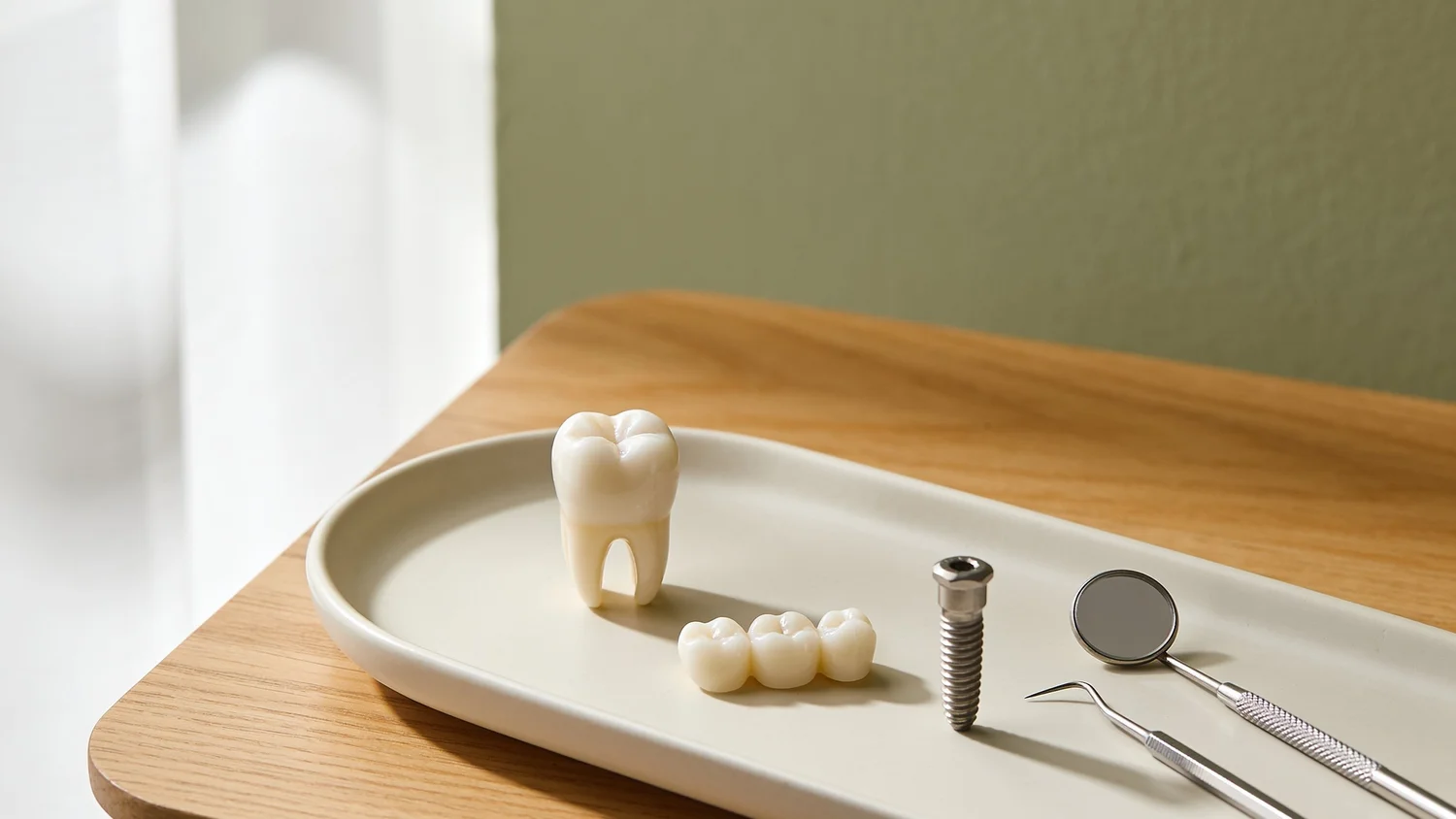
If you are missing one tooth and the teeth on either side are healthy, a dental implant is usually the best long-term choice. If those neighboring teeth already need crowns, a bridge often makes more sense. If you are missing most or all of the teeth in an arch, or you need a working solution quickly and at the lowest upfront cost, a denture is the practical answer. Implants last the longest and protect the jawbone. Bridges are faster. Dentures cost the least to start. The right answer depends on your bone, your neighboring teeth, and your budget.
Last updated: August 3, 2026
What is the actual difference between an implant, a bridge, and a denture?
All three replace missing teeth. They differ in what they attach to.
A dental implant is a titanium post placed into the jawbone that acts as an artificial tooth root. Bone grows around it in a process called osseointegration, and a custom crown is attached on top. It stands on its own and does not touch the teeth beside it.
A dental bridge spans the gap by anchoring to the teeth on either side. Those neighboring teeth, called abutments, are reduced and crowned so they can carry the replacement tooth between them. Nothing goes into the bone.
A denture is a removable appliance that rests on the gum ridge. A partial denture replaces several teeth and clasps onto the remaining ones. A complete denture replaces a full arch. It comes out for cleaning.
| What you are comparing | Dental implant | Dental bridge | Denture |
|---|---|---|---|
| What it replaces | The root and the crown | The crown only | The crowns, and the gum contour |
| How it stays in | Fuses to the jawbone | Cemented to the two teeth beside the gap | Rests on the gum ridge, clasps or adhesive |
| Effect on healthy neighboring teeth | None. They are left untouched | Both are permanently reduced and crowned | Partial dentures put clasp pressure on them |
| Effect on the jawbone | Stimulates the bone the way a root does | Bone under the gap keeps shrinking | Bone under the ridge keeps shrinking |
| Typical time from start to finish | Placement in one visit, then several months of healing before the final crown | Usually a few weeks, sometimes two visits | Usually a few weeks, plus fitting adjustments |
| What long-term studies show | Published reviews put 10-year implant survival above 95 percent | Studies report roughly 72 to 89 percent of bridges still in service at 10 years | Lower dentures commonly need relining every 2 to 5 years as the ridge changes |
| Most common way it fails | Gum and bone infection around the implant, usually tied to hygiene or smoking | Decay or nerve death in an anchor tooth under the crown | Loosening and sore spots as the gum ridge resorbs |
| Upfront cost, relative | Highest | Middle | Lowest |
| Best fit | One or a few missing teeth, healthy neighbors, enough bone | Neighbors already need crowns, or bone volume rules out an implant | Many or all teeth missing in an arch, or budget is the binding constraint |
Which option lasts the longest?
Implants, by a wide margin, and the reason is structural. An implant is titanium fused to bone, so it cannot get a cavity. Published long-term reviews put 10-year implant survival above 95 percent. Our own guidance is that implants can last decades or a lifetime with good care, while crowns and bridges commonly last 10 to 15 years or more.
Bridges do not fail because the bridge itself wears out. They fail because of what is underneath. Long-term studies report that roughly 72 to 89 percent of conventional bridges are still in service at 10 years, and the usual reasons for replacement are decay at the margin of an anchor tooth or loss of nerve vitality in a tooth that was reduced to carry the bridge. One study of bridge retainers found about 71 percent of anchor teeth still had a living nerve at 10 years. When an anchor tooth fails, you are often replacing the whole bridge, not one tooth.
Dentures are the most maintenance-heavy option, and again the reason is biology rather than the appliance. Once a tooth is gone, the bone ridge under it resorbs, fastest in the first 6 to 12 months and then more slowly for years. A denture that fit well at delivery sits on a ridge that keeps changing shape underneath it. Lower dentures commonly need relining every 2 to 5 years, and eventual replacement, to stay stable.
What does each option actually cost?
We do not publish flat procedure prices, because an honest number depends on your mouth. What we do commit to is that you see your exact cost in writing before we touch a tooth. What moves the number is predictable:
| Option | What drives your price up or down |
|---|---|
| Implant | Number of implants, whether a bone graft or sinus lift is needed first, the type of final restoration (single crown, bridge, or implant-supported denture), and whether an extraction is part of the same plan. |
| Bridge | How many units it spans, the material, and whether either anchor tooth needs a root canal or buildup before it can carry the bridge. |
| Denture | Partial versus complete, the material, how many extractions are needed first, and whether you want implants placed to anchor it. |
Be careful comparing quotes on upfront price alone. A bridge that gets replaced twice over 30 years, or a denture relined every few years and remade, can close much of the gap with an implant that is placed once. Ask any office to price the whole arc of treatment, not just the first appointment. Our guide on how to read a dental treatment plan walks through exactly which line items to question.
What if you do not have dental insurance?
This is the situation most of our tooth-replacement patients are in, and it is the reason our membership plans exist. There is no insurance company and no claim forms.
- Cleaning Plan, 300 dollars a year. Two professional cleanings with ozone treatment included, unlimited exams and X-rays, no deductibles or copays. Retail value of that care is 710 dollars, so you save 410 dollars in year one and every year after.
- Loyalty Plan, 600 dollars a year. Everything in the Cleaning Plan plus 50 percent off every treatment, which includes crowns, fillings, extractions, and root canals. That is up to 2,000 dollars in savings a year, double the 1,000 dollar annual cap on a typical insurance plan. It also gives you direct access to our in-house specialists with no referrals and no waiting lists. It carries a 2-year commitment.
If you do have insurance, we take every major PPO, including Delta Dental, MetLife, Cigna, Aetna, Guardian, UMR, Beam, Premera, Principal, Anthem Blue Cross, and SHIP. We verify your benefits before the visit and show you the numbers before you sit in the chair. If your plan is not one we take, your first visit is free. Full details are on our membership page and our payment options page, and we compare the math directly in dental membership plan versus insurance.
Which option is right for one missing tooth?
Start with the two teeth beside the gap. If they are healthy and untouched, an implant is usually the better decision, because a bridge would mean permanently grinding down two sound teeth to fix a problem those teeth do not have. If one or both neighbors already have large fillings or already need crowns, a bridge does two jobs at once and the trade-off changes.
The second question is bone. An implant needs enough bone volume and density to hold it. If you lost the tooth years ago, the ridge may have resorbed past what will support an implant without a graft first. Grafting is routine and we do it at the Rotunda, but it adds months and cost to the plan, and that is worth knowing before you choose.
Which option is right for several missing teeth or a full arch?
With several missing teeth in a row, the options are a longer bridge, a partial denture, or implants that support either. With a full arch, the realistic choices are a complete denture or an implant-supported denture, where a small number of implants anchor the appliance so it does not move.
An implant-supported denture is the middle path many patients land on. It costs less than replacing every tooth with its own implant, but it eliminates the slipping and the adhesive, and the implants slow the bone loss under the ridge. We provide implant-supported dentures and bridges at our Rotunda Specialty Center.
Who does this work at Total Health Dental Care?
Tooth replacement is specialist work, and our specialists are in-house rather than referred out. At our Rotunda Specialty Center at 300 Frank H. Ogawa Plaza, Suite 100, Oakland, CA 94612, Dr. Irene Louie is our periodontist and places and restores implants and performs gum grafting and tissue regeneration. Dr. James Connors is our oral surgeon and handles complex extractions, bone grafting, and ridge augmentation, including the pre-prosthetic surgery that prepares a site for implants. Dr. Amanda Lavorini is our endodontist, which matters here because the honest first question is often whether your tooth can be saved with a root canal instead of replaced at all.
That structure is the practical difference. When your implant needs a graft first, or your bridge anchor turns out to need a root canal, the next appointment is down the hall rather than at another practice weeks out. Patients drive to us from across the Bay Area for same-day root canals, extractions, and implant placement for exactly this reason, which we cover in same-day dentist in the East Bay.
The Rotunda is two blocks from the 12th Street BART station, steps from Oakland City Hall, on the corner of Telegraph and 16th Street with entry from Telegraph Avenue. The Rotunda Parking Garage at 524 16th Street is one block away, and metered street parking is available nearby.
Frequently asked questions
Is a bridge ever the better choice than an implant?
Yes. If the teeth on both sides of the gap already need crowns, a bridge restores all three at once instead of doing separate work. A bridge is also the practical option when there is not enough bone for an implant and you do not want a graft, or when you need the gap closed on a shorter timeline.
How long after losing a tooth can I still get an implant?
There is no hard deadline, but the bone ridge resorbs after a tooth is lost, fastest in the first 6 to 12 months. The longer you wait, the more likely you will need a bone graft before placement. A 3D scan at your consultation shows exactly how much bone you have, so the answer is measured rather than guessed.
Does insurance cover implants, bridges, or dentures?
It varies by plan. Some PPO plans pay a share of bridges and dentures and treat implants as partially covered or excluded, and most plans cap total annual benefits around 1,000 dollars. We verify your specific benefits before treatment and give you the out-of-pocket number in writing.
Can I switch from a denture to implants later?
Often yes. Many patients start with a denture and later add implants to anchor it. The limiting factor is how much bone remains, since years of denture wear allow the ridge to keep resorbing. A consultation with imaging tells you whether you can convert directly or need grafting first.
Where can you find us in the East Bay?
Total Health Dental Care has 13 offices, 12 general practices plus the Rotunda Specialty Center, from El Cerrito down to Fremont and across to the Peninsula. Implant surgery, grafting, and implant-supported restorations are done at the Rotunda; consultations and restorative follow-up can happen at whichever office is closest to you.
- Old Oakland
- 15th Street, Oakland
- Grand Avenue, Oakland
- Temescal, Oakland
- Montclair, Oakland
- Piedmont Avenue, Oakland
- Rotunda Specialty Center, Downtown Oakland
- Dana Street, Berkeley
- Telegraph Avenue, Berkeley
- Albany
- Emeryville
- Marina Village, Alameda
- Belmont
Get your number in writing
The right choice between an implant, a bridge, and a denture comes down to three things we can measure at a consultation: how much bone you have, what condition the neighboring teeth are in, and what you can spend. Bring any recent X-rays. We will lay out every option that genuinely applies to your mouth, including doing nothing for now, with the cost of each in writing before you decide.
Learn more about dental implants, crowns, and our full range of restorative dentistry, or read about our periodontics and gum care. To book, visit our scheduling page or call (510) 495-1075. The Rotunda Specialty Center can be reached directly at (510) 679-1478.
